How to Be Considered for the Art Exhibit Hits Horse
Why museums hide masterpieces away
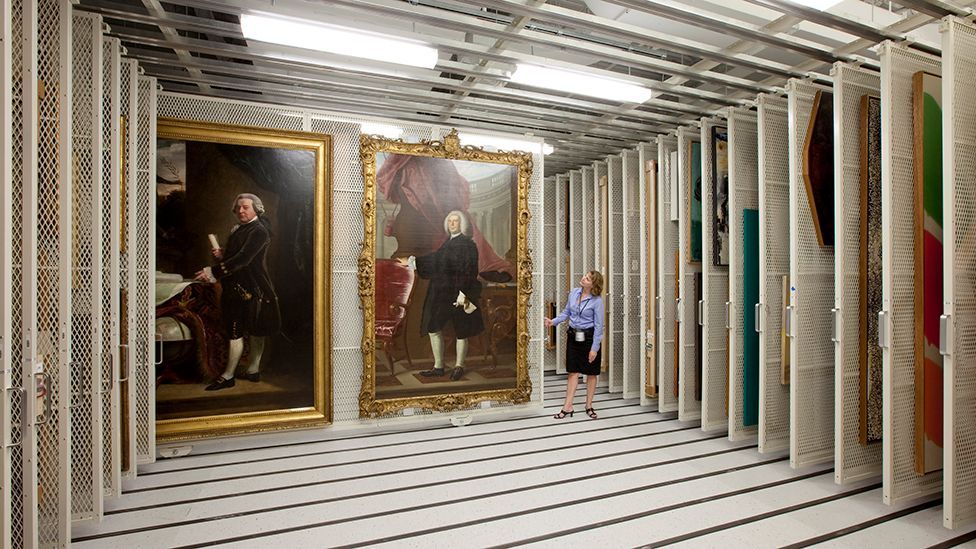
In major museums around the globe, some truly neat works of art are hidden away from public view. What are they – and why can't we run into them? Kimberly Bradley finds out.
T
The numbers don't prevarication. At New York'due south Museum of Modern Art, 24 of 1,221 works by Pablo Picasso in the establishment'southward permanent collection can currently be seen past visitors. But one of California conceptual artist Ed Ruscha's 145 pieces is on view. Surrealist Joan Miró? Nine out of 156 works.
The walls of the Tate, the Met, the Louvre or MoMA may look perfectly well-hung, but the vast majority of art belonging to the globe'south top art institutions (and in many countries, their taxpayers) is at whatsoever fourth dimension hidden from public view in temperature-controlled, darkened, and meticulously organised storage facilities. Overall percentages paint an fifty-fifty more dramatic moving picture: the Tate shows about twenty% of its permanent collection. The Louvre shows 8%, the Guggenheim a lowly iii% and the Berlinische Galerie – a Berlin museum whose mandate is to show, preserve and collect art made in the urban center – 2% of its holdings. These include approximately six,000 sculptures and paintings, fourscore,000 photographs, and 15,000 prints by artists including George Grosz and Hannah Höch.
"Nosotros don't have the space to show more," says Berlinische Galerie managing director Thomas Köhler, explaining that the museum has i,200 sq thousand in which to display works caused over decades through purchases and donations. "A museum stores retentivity, or culture," explains Köhler. Simply here, like in other museums around the world, many works rarely if e'er meet the light of solar day.
A spatial deficit is only one reason why not. Another is mode: some holdings no longer fit their institutions' curatorial missions. Bottom works by well-known artists may also languish – their hits hang on museum walls; their misses lie forgotten in flat files. Works that come up to a museum inside estate acquisitions "might sit around in crates for years, waiting to be sorted," explains Köhler. Some works stay under wraps due to delicacy or impairment – and different institutions take varied storage and rotation policies, depending on a drove'south nature and scope. While London's National Gallery uses a double hang system, thereby increasing the number of its permanent works on view, the Albertina in Vienna possesses more than a million Quondam Main prints – many of them centuries old and very sensitive. The pct on view is thus very low, even if well-nigh of the holdings are kept onsite. (Other museums continue their caches in secret offsite warehouses.)
"Having v% of your national collection on show is something people find difficult to empathise," says British curator Jasper Sharp, who was the commissioner of the Austrian pavilion at the 2013 Venice Bienniale. Many art institutions are thus coming up with means to show their stuff, so to speak. "There is a great move to open up collections," adds Abrupt. Besides digitising images of the permanent collection (which many major institutions are currently in the procedure of doing), one way to display holdings is the idea of the Schaulager (translation: 'storage brandish') – in which visitors can see works archived, on sliding racks, behind glass, or during restoration. The Hermitage's storage facility opened in 2014 and offers guided tours of collections long unseen; a number of United states museums, like the Brooklyn Museum of Art have also created accessible storage centres. Other museum expansions – the Tate, the MoMA, and the Met are just a few currently underway – are meant to increase space for permanent drove viewing.
Until visible storage is everywhere – or museums abound and then large that everything is on view, like a massive database – here are a few examples of wonderful things not frequently seen, and why.
Albrecht Dürer, Young Hare (1502)
Albertina Museum, Vienna
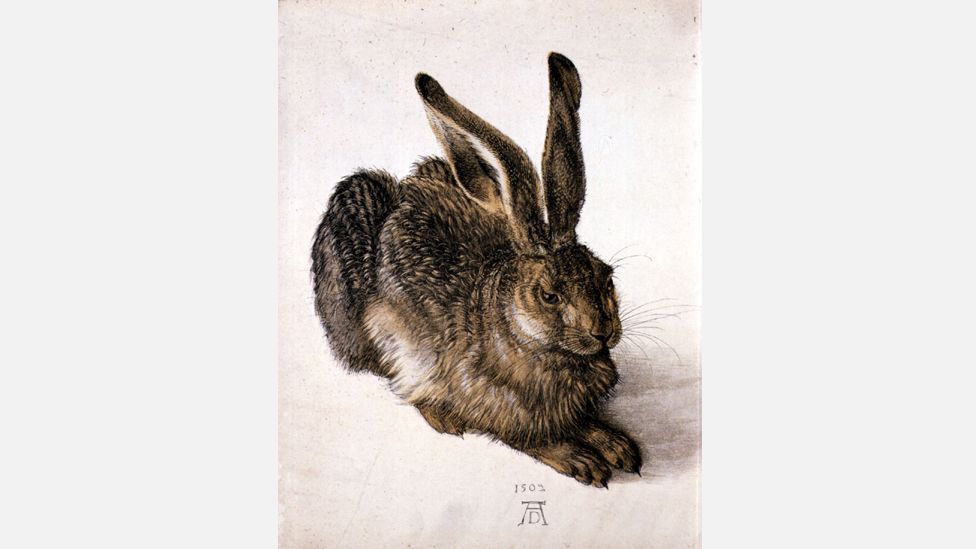
Albrecht Dürer, Young Hare, 1502 (Corbis)
Dürer's famous watercolour and gouache drawing Young Hare is a masterpiece in observation; its impeccable rendering served every bit benchmark for centuries thereafter. Equally 'Vienna'south unofficial mascot', the work on paper is also the Albertina'due south prize possession, just it's non ofttimes on show. After a maximum of three months, Immature Hare needs five years in night storage with a humidity level of less than 50% for the newspaper to adequately rest. Information technology was on view briefly in 2014 later a break of ten years, and will appear again for a brusque time in 2018, before information technology goes back into hiding. The museum holds millions of works on newspaper, and is thus able to bear witness "less than 1% – possibly even 0.1% – of our drove," according to deputy managing director Christian Benedik, simply, as mandated by the museum's original owners (part of the Habsburg royal family) every graphic work has a facsimile that can be viewed more readily, including 1 of Immature Hare. A Google Cultural Institute Gigapixel image of the Hare is digitally viewable – the improve to see the reflections in the bunny'southward eyes with.
Henri Matisse, The Swimming Puddle (1952)
Museum of Modern Art, New York
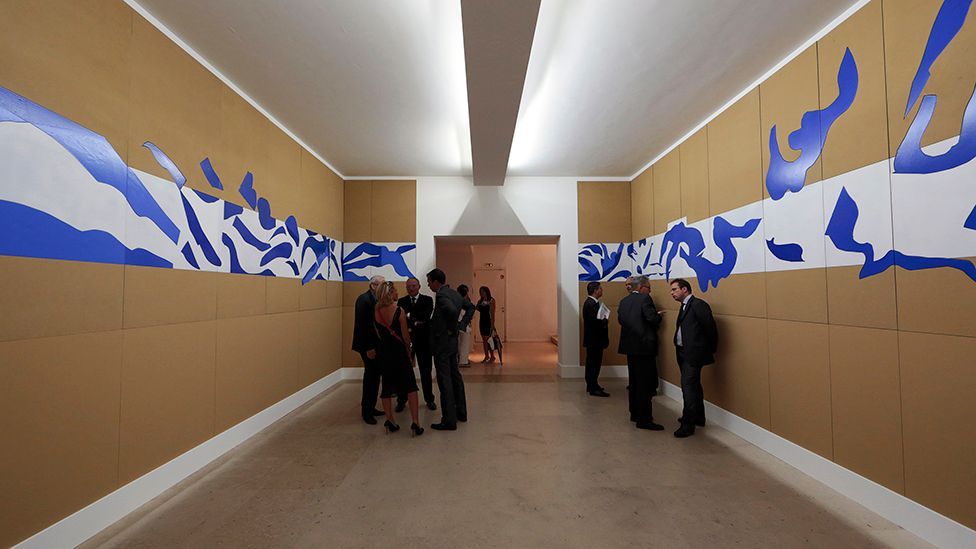
Henri Matisse's The Swimming Pool installed at MoMA (Corbis)
The undulating ultramarine waves and swimmers of Henri Matisse's The Swimming Pool, a big paper installation made for the creative person's dining room in Nice, are in fact currently on view in the exhibition Henri Matisse: The Cut-Outs until Feb 10 at New York's Museum of Modern Art. Only the work, acquired by MoMA in 1975, was out of sight for nearly 20 years. Its burlap backing had become discoloured and brittle; the white newspaper frieze on which the blue cut-outs were mounted was stained. The long procedure of the work's restoration was indeed the impetus behind this highly acclaimed exhibition that represents Matisse'southward last major work serial; later the exhibition closes, the piece of work will be unpinned and returned to customised, climatised storage cases. But the situation behind its temporary retirement isn't completely unusual – oft, an artwork needing restoration will wait months, even years for an update.
Jackson Pollock, Mural on Red Indian Ground (1950)
Tehran Museum of Contemporary Art, Tehran
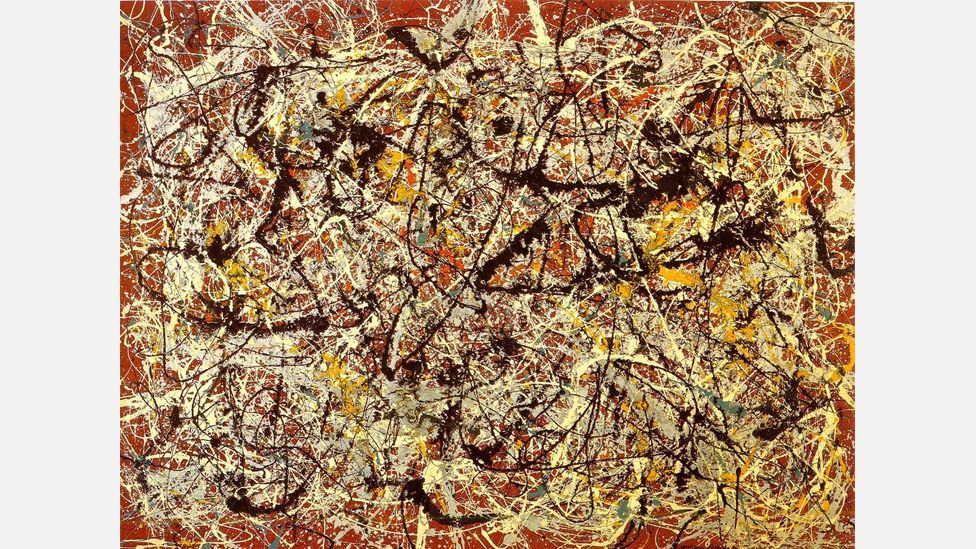
Jackson Pollock, Mural on Ruby Indian Basis, 1950 (Wikimedia Commons)
In the last years of the Iranian Shah'south rein, during a particularly affluent oil-blast period, the Iranian queen Farah Pahlavi assembled a formidable collection of modern fine art, at present valued at several billion United states dollars. The Picassos, Pollocks and Warhols (among many other household names) in Tehran's Contemporary Art Museum were viewable from the museums' opening in 1977 until the Iranian Revolution in 1979 at which fourth dimension the art was deemed 'Western', ie corrupt and unsuitable for viewing. Curators spirited the art away into a climate-controlled basement vault – there, it has been safety not only from climate extremes but also knife-wielding revolutionaries. The artworks are oft lent to other world institutions, but display in Tehran depends on who is leading the land – a few works were mounted in a Pop Art/Op Art show here in 2005, but whatever works depicting nudity or homoerotic overtones, like Bacon's 2 Figures Lying on a Bed With Attendants, remain hidden.
Franz Marc, The Big Bluish Horses (1911)
The Walker Fine art Center, Minneapolis
Franz Marc, The Large Blue Horses, 1911 (Wikimedia Commons)
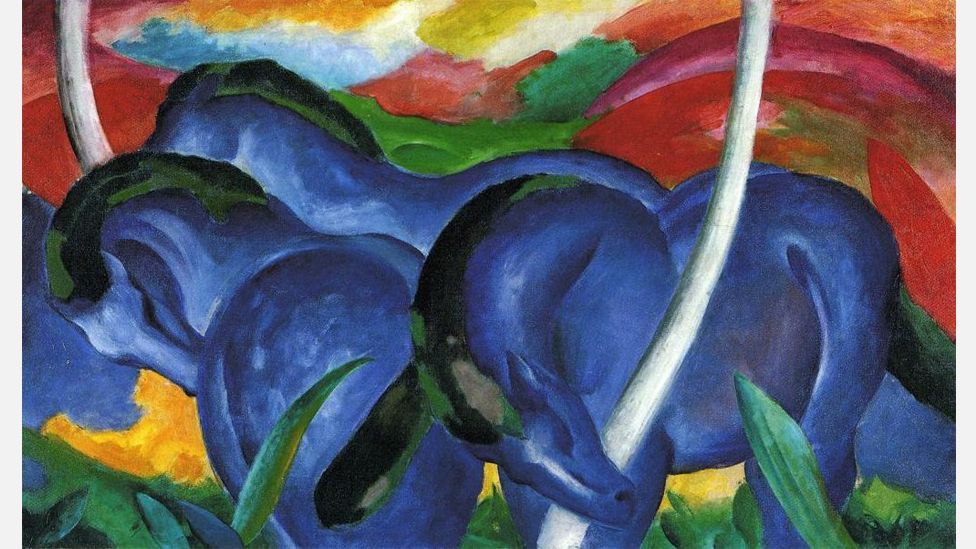
The Walker Fine art Center's current incarnation dates from 1940, and its first acquisition was The Big Blue Horses past the High german painter Franz Marc. The painting – which Adolf Hitler had accounted 'degenerate' and whose sale to the Walker in 1941 was finalised the week bombs fell on Pearl Harbor – represented the museum's first foray into modernistic fine art, at the time a daring move. In the intervening decades, the Walker'south curatorial emphases have shifted: the museum is known for its post-1960s holdings and operation programs, and the painting is seldom shown. "Information technology'southward been i of these mythic works in the drove that rarely gets exhibited," says curator Eric Crosby. "This is a piece of work that is very much central to the Walker's mission in the 1940s – but as contemporary art has changed nosotros take less context in which to exhibit it." Nonetheless, the Marc is on view there now until September 2016 in a special anniversary exhibition Fine art at the Middle, 75 Years of Walker Collections.
Edward Kienholz, The Art Show (1963-1977)
Berlinische Galerie, Berlin
Edward Kienholz and Nancy Reddin Kienholz, The Art Show, 1963-1977, Berlinische Galerie, © Nancy Reddin Kienholz (Kai-Annett Becker)
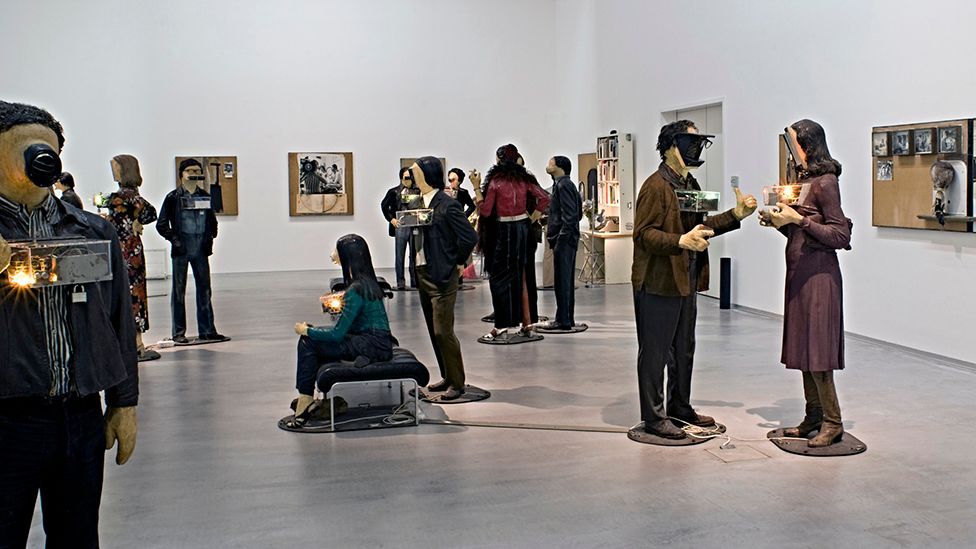
At the Berlinische Galerie, American artist Edward Kienholz'due south The Art Show –a large-scale installation of visitors viewing an exhibition, with ventilators where their mouths should be –is rarely on view simply because its scope requires an entire gallery within the museum. Co-ordinate to museum manager Thomas Köhler, Kienholz'due south work, an instance of Assemblage art, also takes a groovy deal of energy and time to assemble properly. Portions of the piece – a figure's vintage spectacles, for instance – besides frequently need to exist replaced, sending the restoration team to flea markets.
The Coronation Carpet (1520-xxx) and Ardabil Rug (1539-40)
Los Angeles County Museum of Art, Los Angeles
The Coronation Carpet, 1520-thirty (Los Angeles Country Museum of Art)
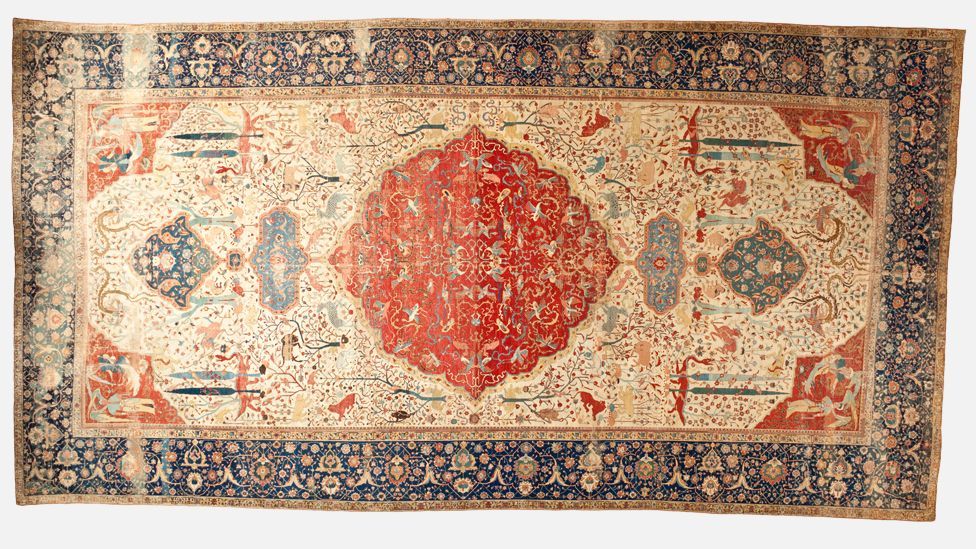
It'due south a tale of two carpets, times two. The Ardabil Carpet is well-known to visitors of the Victoria and Albert Museum in London. The lusciously detailed Persian textile is covered to preserve its centuries-old fibres and lit for just 10 minutes each hour. But there is a slightly smaller version at the Los Angeles County Museum of Art (LACMA), along with second like rug called the Coronation Carpeting, so named because it was laid before the throne at Westminster Abbey for the crowning of Edward VII in 1902. The LACMA rarely displays either, because of their large size and farthermost sensitivity to light. It pays to be cautious: a mere bit is all that's left of the Coronation Carpet'southward mate, on display at Berlin's Museum of Islamic Art.
Tino Sehgal, This is Propaganda (2002)
Tate Modern, London
British-born, Berlin-based artist Tino Sehgal turns fine art storage on its caput. Why? As performative work – executed not by Sehgal himself simply past his trained 'interpreters' – it is completely immaterial. Unlike other artists in this field, Sehgal besides stipulates that no record whatsoever remains of the work – no photos, no recordings, no press releases; only the feel. That rule even extends to institutional sales agreements of his piece – a auction similar that of This is Propaganda, which Tate bought in 2005, is verbally executed. The artist, the buyer, a lawyer and a notary are nowadays; all rules and regulations around the piece are committed to a designated person'due south memory. So This is Propaganda (which sees a gallery guard singing "This is propaganda, you know, yous know, this is propaganda, Tino Sehgal, This is propaganda, 2002" to every visitor who enters the space) exists only in the heed. Imagine that.
If you would like to comment on this story or anything else yous have seen on BBC Culture, head over to our Facebook page or message us on Twitter .
Source: https://www.bbc.com/culture/article/20150123-7-masterpieces-you-cant-see

Postar um comentário for "How to Be Considered for the Art Exhibit Hits Horse"